
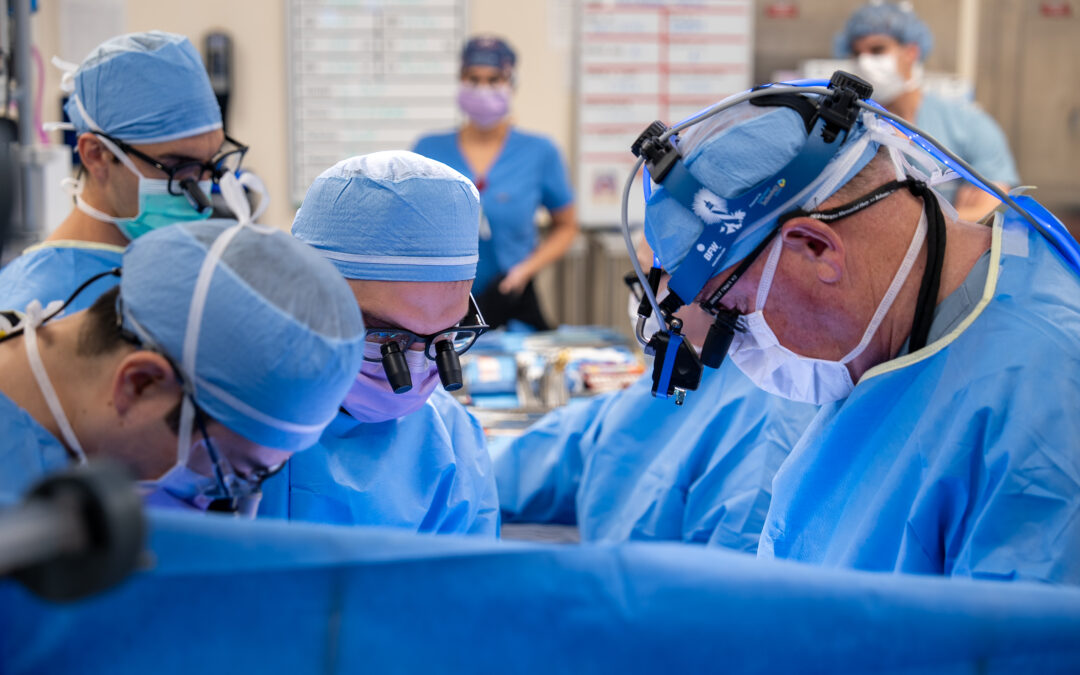
In December of 2025, during the hallowed hours between Christmas Eve and Christmas Day, surgeons at Dell Children’s Medical Center in East Austin reached a historic milestone: the hospital’s 50th pediatric heart transplant.
Achieved in just five years, the moment marked a transformation in what is possible for children and families across Central Texas. Since performing its first transplant on October 3, 2020, the program has surpassed even the most optimistic projections, expanding access to life-saving cardiac care in a region that had long lacked it.
Filling a Critical Gap in Care
When transplant coordinator Dr. Chesney Castleberry arrived in Austin from St. Louis in 2019, she set an ambitious goal for the program: 50 transplants in five years.
Early data revealed a troubling reality. Each year, 10 to 15 Texas children lacked access to a heart transplant, even in a state with established programs at Texas Children’s Hospital in Houston and Children’s Medical Center Dallas.
“That has been our patients’ stories,” Dr. Castleberry said. “They’ve either not gone to get help, not traveled for care, or they were turned down by other centers.”
 Dr. Charles Fraser Jr., who came to Austin in 2018 to establish the Texas Center for Pediatric and Congenital Heart Disease at Dell Children’s and UT Health Austin, reflects on the program’s rapid growth with both pride and purpose.
“We are certainly busier than I thought,” he said. “We’re filling a role here in Austin that was missing.”
The 50 patients served by the program, ranging from infants to young adults in their 20s, once would have had to relocate to Dallas, Houston, or even farther for care. For families already facing the uncertainty of a child awaiting transplant, that distance often meant months away from home, jobs, siblings, and support systems, which would mean an emotional and financial burden many simply could not carry.
Building a World-Class Program
The milestone of 50 heart transplants is only one chapter in a much larger story of rapid growth in Dell Children’s cardiac program.
In just five years, the center has performed more than 2,000 heart surgeries while introducing a series of cardiac firsts for the Austin region:
- The first left ventricular assist device placement in Austin (2019)
- The first pediatric heart transplant in Austin (2020)
- The first Berlin mechanical heart in Austin (2021)
- The first baby managed through the Comprehensive Fetal Care Center to undergo an immediate heart procedure after birth (2021)
- The first Dell Children’s-born baby to receive a heart transplant (2023)
- The first partial heart transplant in the region (2023)
- What is believed to be the world’s first baby to receive a mechanical heart within the first day of life as a bridge to transplant (2024)
In October 2025, U.S. News & World Report ranked Dell Children’s the No. 10 pediatric heart program in the nation, a recognition that once seemed ambitious.
“I thought maybe top 20,” Dr. Castleberry admitted.
Much of that progress can be contributed to the launch of Dell Medical School in 2016, which attracted physicians eager for the rare opportunity to build a program and a medical school simultaneously. Today, medical students and residents regularly observe procedures in the cardiac operating room, and a new cardiac fellowship will launch this July, helping train the next generation of pediatric heart specialists.
Dell Children’s has intentionally positioned itself as a program willing to take on patients other centers have turned away.
Dr. Fraser describes this philosophy as being “risk-liberal,” carefully considering donor hearts for patients who might not qualify elsewhere rather than declining cases to protect program statistics.
 That approach means caring for some of the most medically complex patients in the country. Of the program’s 50 transplant recipients, 37 were born with single ventricles, a condition that makes heart anatomy far more complex than the typical two-ventricle structure. Many had already undergone multiple surgeries before transplant, and several carried complicated antibodies that made finding a compatible donor heart especially challenging.
Despite the complexity of these cases, Dell Children’s five-year transplant success rate stands at 89%, with a program goal of 90% or higher.
Some centers decline the most critical patients to protect their outcomes data.
“That’s not how Fraser or I want to play these odds,” Dr. Castleberry said. “For better or worse, I come from a place of ‘yes.’ … I love the tough ones. That’s my jam.”
Many of their patients arrive with only an 80% survival probability. Achieving outcomes close to 90%, she says, means “we’re beating the odds.”
Dr. Castleberry is equally focused on what happens after transplant. Using patient genetics and specialized blood testing, she tailors anti-rejection medications for each child. She also sees artificial intelligence as a promising tool for analyzing outcomes data and refining treatment strategies over time.
The Road Ahead
The most persistent challenge facing Dell Children’s and every transplant center is organ availability.
 Today, 10 patients at Dell Children’s are awaiting a heart transplant. Several are infants, who often face longer waits because they require smaller donor organs.
Both Dr. Fraser and Dr. Castleberry are passionate advocates for organ donation. While advances in mechanical hearts and research into animal heart transplantation offer promise, Dr. Fraser remains clear-eyed about the current reality.
“There’s a lot of magic to the human heart that we haven’t been able to replicate,” he said.
Looking ahead, Dr. Castleberry hopes to grow the program to 15 to 20 transplants each year, reaching 150 by the program’s 10th anniversary.
Dr. Fraser, however, is less focused on numbers than on the principles guiding the program’s work.
“Growth will come if you do the right thing,” Dr. Fraser said.
Transformational Philanthropic Partnership
The extraordinary progress achieved by the Dell Children’s transplant program over the past five years has been made possible, in part, through transformational philanthropic partnerships.
Visionary donors have helped build the specialized infrastructure, recruit world-class physicians, and create the conditions for this kind of life-saving innovation to take root in Austin. Their generosity is woven into every breakthrough and every life saved.
Because of that support, families across Central Texas now have access to world-class pediatric heart care close to home. And more children are being given the chance to grow up with healthy hearts.