
Note: This content discusses child abuse, which may be distressing or triggering for survivors of trauma.
Nights are different in Dell Children’s Pediatric Intensive Care Unit. The hustle and bustle of daytime care is replaced by something quieter and even more tender. The lights are dimmed, nurses voices soften to whispers, and the comfort of bedtime rituals takes on a new level of importance.
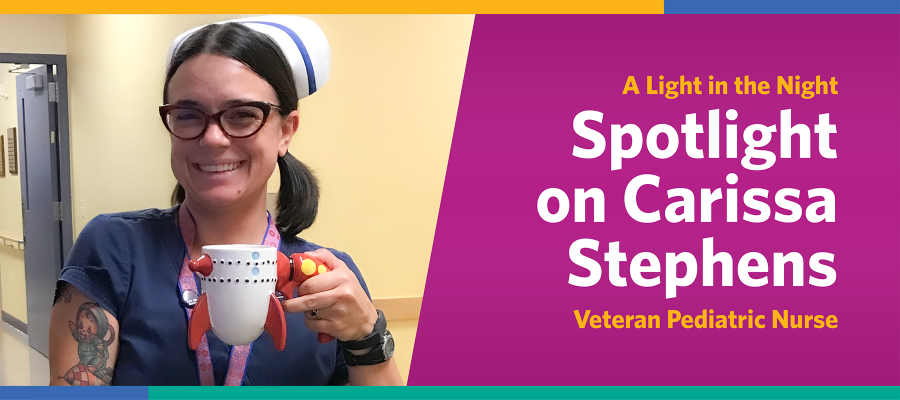
In the halls of the PICU after dark, you’ll find Carissa Stephens—clinical lead, veteran nurse, and self-appointed “sleep champion.” She moves quietly from room to room. She checks vitals, lowers glowing monitors, offers tea and eye masks to tired parents, and then does the thing she loves best as she tucks in her patients for the night — she flips their pillows to the cool side.
“It’s such a small thing to turn over someone’s pillow to the cool side,” she says. “But I like to do it for people.”
Carissa has been a nurse since 2003 and joined Children’s Hospital of Austin in March 2006, just a year before it became Dell Children’s, after hearing about the PICU’s uniquely collaborative, family-centered culture. Pediatric nursing hadn’t been part of her original plan, but she quickly discovered that teamwork, trust, and shared purpose brought out her very best. Little did she know just where that path would lead.
A Shift That Changed Everything
Carissa’s first day in pediatrics tested her resolve and very nearly broke her spirit. She was assigned to care for a child who had died from abuse and was being prepared for organ donation.
“At that time, I was so young and naive that I didn’t even realize children could die from abuse,” Carissa remembers softly. “I couldn’t wrap my head around it.”
At the end of that grueling shift, a social worker invited her to sit in on a meeting with child-abuse experts, law enforcement, and advocates. During that meeting, she saw something she hadn’t expected: a community determined to make sure this child’s story mattered. Justice would be sought. Care would continue in another form. That glimpse of purpose and solidarity was enough to carry her back for day two—and every day since.
The Math of Miracles
When asked what keeps her going, Carissa doesn’t hesitate: the miracles, the people, and the way nights make space for both.
“There are kids you almost feel sure won’t make it—and then they do,” she says. “I tell people that one miracle undoes ten tragedies, but honestly, at Dell Children’s, I don’t have to do that math. We see more miracles than tragedies.”
One Christmas Eve, Carissa witnessed a moment she’ll never forget. A child who had endured two hours of CPR in our Emergency Department suddenly spoke after days of silence. “I told him it was Christmas Eve,” she recalls. “To my complete surprise, he said, ‘Santa’s coming! I have to get out of here.’” Carissa picked up the phone and called his parents in the middle of the night. Some moments, she knew, simply couldn’t wait.
Creating Dignity in the Dark
For Carissa, the night shift carries a certain reverence. With fewer resources, nurses lean on each other and create dignity in the smallest details. One night, when a baby needed baptism and only a sterile pink plastic basin was available, Carissa offered her own ceramic soup bowl. “I wanted the moment to look like what it truly was: sacred, human, full of love.”
Today, families can borrow proper items for bedside blessings—thanks to the creativity of nurses like her.
Getting Better Every Day
Over the years, Carissa has become one of the steady heartbeats of the PICU. She spent ten years on the ECMO team, mentored new nurses into transport and advanced practice roles, and now leads night shifts with calm precision.
Last October, she became a Sexual Assault Nurse Examiner, a calling rooted in that very first patient and deepened by walking alongside a friend through her child’s abuse trial. “What happened already happened,” she says. “But we can help kids get better, seek justice, and move forward.”
Carissa is also a mother of three teenagers and, in 2020, carried and delivered a baby for her sister. Parenting and nursing have shaped one another in countless ways. “The work makes me safer with my kids, yes,” she says, “but more than that, it’s given me the conviction that talking about hard things saves lives.”
That same conviction carries into her life outside the hospital. Carissa volunteers at a cooling center for unhoused neighbors, serves with street medics at community events, and steadies her own breath by swimming laps to the rhythm of her favorite band. “We help our communities. We take care of our communities,” she says.
Holding Space for Families
The hardest part of the job? “A parent’s cry,” she says, without any doubt. “When bad news lands, that sound is like no other in the world.” It’s why the little mercies matter so much: the cool pillow, the dimmed lights, the nurse who stays.
To aspiring pediatric nurses, her advice is simple: don’t give up. “Nursing school is brutal,” she says with a smile. “But if you can hang on until you get your own room and your own patient—when you finally get to do the work—it’s worth it.”
Nearly twenty years after her first shift, Carissa carries the same conviction that brought her to Dell Children’s: that teams who listen save lives, and that love shows up in details. “We are what we have at night,” she says. “And somehow, together, it’s enough.”