
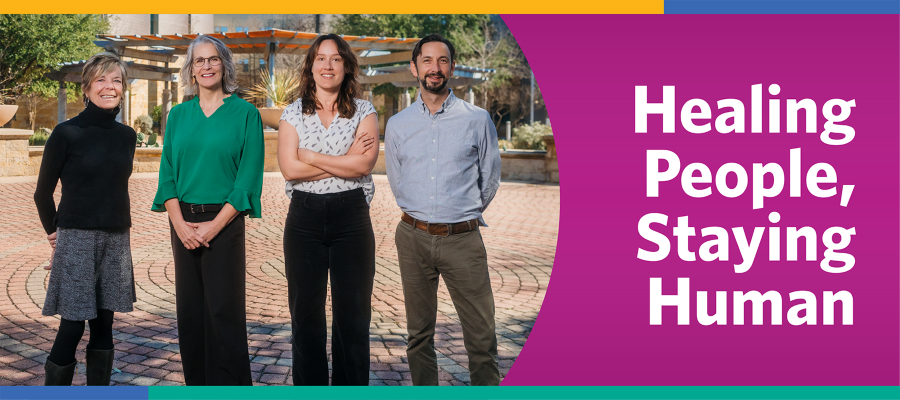
Ten years ago, Krista Gregory approached her colleagues with a simple yet urgent question: How can we heal people and stay human while we do it?
At the time, she was sitting with physicians and residents who were carrying enormous weight: the grief, moral distress, and relentless pressure of caring for critically ill children. At that time, there was no formal program or roadmap for helping these physicians navigate these emotions and stressors. There was simply a growing recognition that something deeper was needed.
What began as a lunchtime conversation with a group of overwhelmed pediatric residents would eventually grow into the Center for Resiliency, a nationally recognized resource that equips healthcare providers with the tools and support they need to sustain both their work and their humanity in the face of unrelenting stress and moral injury.
Born from Physicians’ Voices
In 2014, a program director confided to Gregory that new doctors were “too emotional” and at the time, asked her to help “fix them.”
However, she quickly understood that “fixing them” wasn’t the appropriate course of action. This wasn’t something that could be “fixed.” Instead, she pursued a different tactic. She decided to listen, and what she quickly discovered had nothing to do with clinical competency.
“What they were struggling with wasn’t how to intubate,” Gregory said. “It was how to do life.”
Week after week, over brown-bag lunches, residents gathered to talk honestly about fear, grief, and moral distress. They asked each other tough questions: What do you do when your values conflict with institutional policy? How do you carry the weight of a child’s death? Should you keep a list of every patient who didn’t survive?
“The residents didn’t need fixing,” Gregory said. “They needed space to tell the truth about what this work costs.”
Word spread quickly. Senior physicians began asking for the same support.
“We’re struggling too,” one attending told her.
Out of those conversations, and with the backing of a visionary donor who understood that “if you don’t take care of your people, none of it really works,” the Center for Resiliency was born in March of 2016.
Healing People, Staying Human
Today, the Center for Resiliency offers 11 programs built around its guiding phrase: Healing People. Staying Human.
The programs range from “Mortals in Medicine,” a storytelling night modeled after The Moth, to evidence-based resiliency training published in leading medical journals. Each initiative is designed to equip clinicians with practical tools while creating space for authentic conversations.
Her work meets physicians in real time: in operating rooms, hallways, and intensive care units. She teaches clinicians how to recognize when they are operating from the brain’s fight-or-flight center and how to return to clear, grounded decision-making.
“In that moment, you don’t need to be in your amygdala,” she said. “You need to be in your prefrontal cortex so you can make the next critical decision for that child.”
The goal is not to eliminate emotion but to help clinicians navigate it without becoming overwhelmed or disconnected.
“I tell them, if you aren’t okay, then none of us are okay,” Gregory said. “We’re all working together toward the same goal. We’re all interconnected.”
Why It Matters
Gregory often shares the story of a PICU physician who was weeks away from leaving medicine because of burnout. Her 25 years of experience ultimately helped save the life of a child who had exhausted all other treatment options.
“If she had left,” Gregory said, “what would have happened to that child?”
That question lies at the heart of the Center for Resiliency.
When Dell Children’s invests in the well-being of its physicians, nurses, and care teams, it protects not only their mental health but also their irreplaceable knowledge and steadiness. Burnout is not simply a workforce issue; it’s a patient-care issue.
During the pandemic, communities applauded healthcare workers from their windows. Behind the scenes, however, clinicians were making impossible life-and-death decisions.
“Physicians were losing their lives over those decisions,” Gregory said. “What happened in COVID wasn’t new for us. It was an extreme version of what’s been happening for decades.”
The Center for Resiliency provides a place where clinicians can process those experiences, reconnect with purpose, and learn tools that allow them to continue caring for others without losing themselves.
“This is not optional,” Gregory said. “It affects everything.”
An Invitation to Support
For families whose children have received care at Dell Children’s, gratitude runs deep. Patient families are often looking for ways to give back, and Krista Gregory has a suggestion.
“I want families to say, maybe I can invest in something that allows them to be the people I know they want to be,” she said. “Not just for my child, but for every child after that.”
A gift to the Center for Resiliency is a gift to every patient and family who walks through Dell Children’s doors, not just today, but for years to come. It helps ensure that when a crisis unfolds, there is a skilled, present, and compassionate professional on the other side of the bedside.
Healing people and staying human isn’t just a tagline. It’s the foundation of care. And together, we can make sure it endures.