
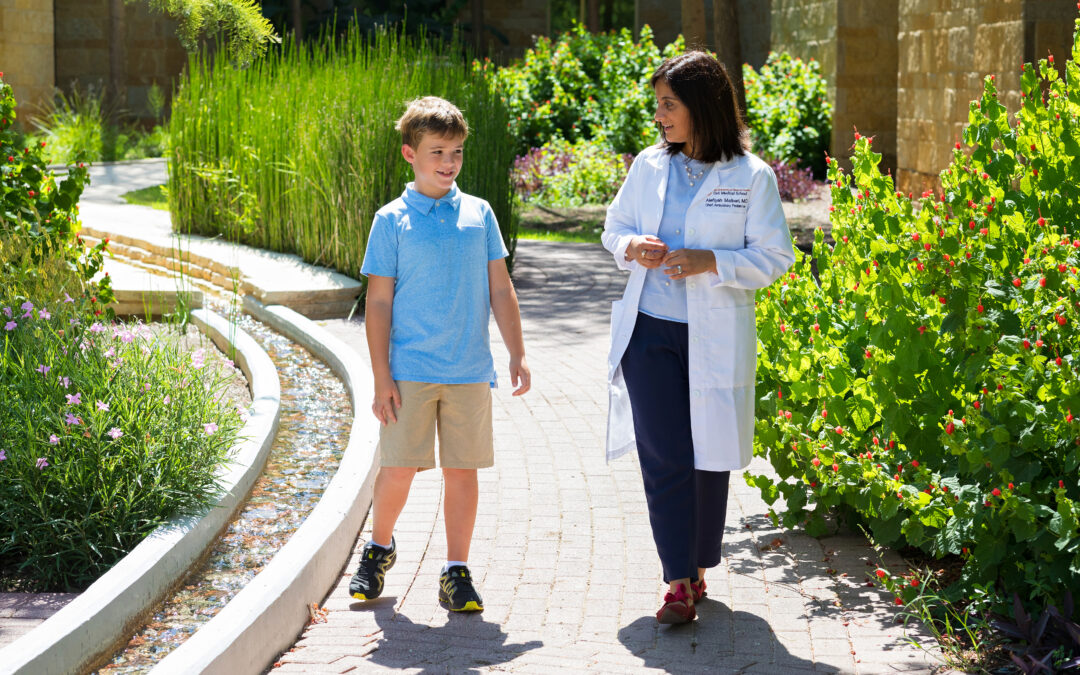
When Dr. Alefiyah Malbari arrived in Austin five years ago, she found a community of children in real need and came with a mission to match it: build a pediatric practice that could care for every child, regardless of status or circumstance.
In Central Texas, despite its rapid growth and deep resources, a Foster Care Center of Excellence didn’t exist. Not one. In a region stretching between Houston and Dallas, home to thousands of foster children moving through a system that too often loses track of them, there was nowhere specifically equipped to provide the coordinated, expert healthcare they deserve.
Today, thanks in part to Dr. Malbari’s steadfast leadership, Dell Children’s Ambulatory Pediatrics is that place.
A Practice Built for Everyone
The clinic in Mueller opened as Dell Children’s first brick-and-mortar outpatient general pediatrics home. It was designed from the start to see all patients, regardless of insurance, Medicaid, private, Superior Health (the insurer for all Texas foster children), or no insurance at all. That decision turned out to matter enormously for foster families.
“Foster parents will come in with two biological children on private insurance and two foster children on Superior Health,” Dr. Malbari explains. “They can bring all of their kids to our practice. They don’t have to go somewhere for one and somewhere else for the other. Everyone gets the same standard of care.”
That may sound simple. For the families it serves, it’s a lifeline.
The Invisible Problem: Continuity
Foster children move around a lot. With each move comes a new caretaker who is often at a loss for records: the vaccine history, the developmental note, the specialist referral that was finally in progress. A child can be worked up again and again, as if no one has ever asked these questions before. The trauma of that compounds.
The Foster Care Center of Excellence designation, offered by Superior Health, exists to address exactly this. As a designated center, Dell Children’s is now part of a network with shared resources and a system that helps maintain a medical record that travels with the child.
“If we know where they’re going next,” Dr. Malbari says, “we can connect them with another center of excellence in that city. We can pass that information on. We can talk to the case manager.”
It’s coordination that the system doesn’t guarantee, but that these children need desperately.
More Than Primary Care
What made Dell Children’s application stand out wasn’t just a willingness to see foster kids. It was everything already built around them.
The clinic includes an embedded autism evaluation program, one of the only such programs in Austin, where community wait times for a diagnosis can stretch beyond a year. Without a diagnosis, children cannot access autism-specific services. Early intervention changes outcomes. The clinic is closing that gap.
There’s also an embedded behavioral health nurse practitioner and a collaborative care program that connects children who screen positive for anxiety or depression directly to a social worker and child psychiatrist — no outside referral, no waitlist, no risk of losing the child in the handoff.
For foster children, who disproportionately carry the weight of early trauma, these aren’t extras. They’re essential.
What the Designation Means
Central Texas had no Foster Care Center of Excellence until recently. Now it is among the first health care providers in the area to receive the designation. Dell Children’s was welcomed into the program, in part because the infrastructure was already there, but the need is only growing. The number of foster families in the region is substantial, particularly in the northern suburbs, where larger homes and community networks make fostering more accessible.
Dr. Malbari puts it plainly: “These kids don’t just need someone to see them. They need someone to know them.”
For every foster child who walks through the door, Dell Children’s is working to be exactly that: a genuine medical home, possibly for the very first time.